
Gravel Calculator – How Much Gravel Do You Need?
Instantly calculate gravel volume, weight in tons, and cost using verified density data — just enter your measurements and gravel type.
Gravel Calculator
Work out how much gravel you need — by volume, weight, and cost — for any shape, unit, or region. Results update as you type.
Measure your area
Choose the shape that best matches your space.
Choose your depth
Or pick a common depth (inches):
Select gravel type
Densities shown are typical industry estimates for planning purposes, not verified lab figures — confirm with your supplier before ordering. The wet-weight adjustment (+8%) is a placeholder estimate and should be confirmed before publishing.
Region & units
Project type (optional)
Overage & compaction
Price & cost (optional)
Your Estimate
Fill in your measurements to see your estimate.
How to Use the Gravel Calculator
Calculating bulk aggregate isn’t rocket science, but getting the math wrong means either paying for a second delivery fee or staring at a massive, unused pile of rock taking over your lawn. Follow these four steps to get an exact tonnage and cost breakdown before you call the quarry.
Step 1 – Measure Your Area
To figure out how much gravel you need, start by getting accurate ground measurements in feet (or meters). Always measure the actual footprint of the space you plan to excavate or cover—do not estimate from memory or rely on property line blueprints.
Rectangular Area (length × width)
For standard driveways, walkways, and rectangular patio bases, run a tape measure along the total length and width.
- The Formula: Length × Width = Square Feet
- Real-World Example: A standard two-car driveway measuring 20 feet wide by 40 feet long gives you a footprint of 800 square feet (20 × 40 = 800 sq ft).
Circular Area (using diameter/radius)
For round fire pits, circular turnarounds, or curved garden features, measure straight across the widest point of the circle to find your diameter, then divide that number by two to get the radius.
- The Formula: π × Radius² = Square Feet (using π ≈ 3.14159)
- Real-World Example: If your circular fire pit patio measures 12 feet across, the radius is 6 feet. Multiply 6 × 6 = 36, then multiply 36 × 3.14159 to get roughly 113 square feet.
Triangular or Irregular Area (split into shapes and sum)
Most real yards aren’t perfect rectangles. If your project area has curves, doglegs, or angles, break the overall footprint down into smaller, manageable sub-shapes (rectangles, right triangles, or semi-circles), calculate each piece separately, and add them together.
- Triangular Formula: (Base × Height) ÷ 2 = Square Feet
- Irregular Strategy: Sketch the project on a sheet of paper. Grid off the layout into simple geometric blocks. Measure each block in the field, calculate their individual square footage, and sum them up to get your total base area.
Step 2 – Choose Your Depth (recommended depth by use case, in inches/cm)
Depth makes or breaks an aggregate project. Too thin, and weeds poke through while tires push the stone directly into the mud beneath. Too deep, and car tires pull up or sink, making driving feel like navigating loose beach sand.
Pro Tip on Compaction: Loose gravel settles significantly once rolled, driven on, or compacted with a plate compactor. Always account for an extra 15% to 20% in total volume to hit your final target depth after compaction.
Recommended Material Depth
| Use Case | Recommended Depth (Inches) | Recommended Depth (cm) | Construction Purpose |
|---|---|---|---|
| Shed Base / Hot Tub Pad | 4″ – 6″ | 10 – 15 cm | Purpose: Needs deep structural support over a crushed sub-base to prevent settling under heavy static weight. |
| Gravel Driveway (Top Surface) | 2″ – 3″ | 5 – 8 cm | Purpose: Driveways need a 4″–6″ base of crushed stone (like Crusher Run), topped with a 2″–3″ surface cap of sharp aggregate. Deep top layers trap tire treads. |
| Walkways & Footpaths | 2″ – 3″ | 5 – 8 cm | Purpose: Provides a firm, comfortable walking surface without causing heels or wheelbarrows to sink. |
| French Drains & Pipe Bedding | 8″ – 12″ | 20 – 30 cm | Purpose: Surrounds perforated pipe to allow maximum water flow while filtering out surrounding soil silt. |
| Decorative Flower Beds / Mulch Alternative | 2″ – 3″ | 5 – 8 cm | Purpose: Thick enough to block sunlight and suppress weeds without smothering shallow plant roots. |
Step 3 – Select Gravel Type (density auto-fills)
Not all stone weighs the same. A cubic yard of light, airy crushed granite weighs noticeably less than a dense, water-packed crushed limestone with fine stone dust mixed in. Weight depends on aggregate size, shape, and moisture content.
When you select your material in the driveway gravel calculator, the tool automatically assigns an average dry bulk density (typically measured in pounds per cubic yard or tons per cubic yard) to convert your volume measurement into delivery weight.
- Crushed Stone / Gravel #57 (1/2″ to 1″ clean stone): Average density of 2,500 to 2,700 lbs/yd³ (~1.25 to 1.35 tons/yd³). The industry standard for driveway topcoats, French drains, and concrete mixes.
- Pea Gravel (1/4″ to 3/8″ smooth, rounded stone): Average density of 2,600 to 2,800 lbs/yd³ (~1.3 to 1.4 tons/yd³). Smooth river stone used primarily for dog runs, patios, and barefoot-friendly garden paths.
- Crushed Limestone / Crusher Run (Stone dust mixed with crushed aggregate): Average density of 2,700 to 2,900 lbs/yd³ (~1.35 to 1.45 tons/yd³). Packs down like concrete; ideal for driveway sub-bases and retaining wall foundations.
- Decomposed Granite (DG): Average density of 2,700 to 3,000 lbs/yd³ (~1.35 to 1.5 tons/yd³). Natural silt-like material that packs tight for stable pathways and rustic patio spaces.
Step 4 – Read Your Results (cubic yards/feet/meters, tons, and estimated cost)
Once you enter your dimensions, target depth, and aggregate material, the pea gravel calculator outputs three distinct metrics to help you plan your purchase:
Total Volume (Cu. Yds / Cu. Ft) ➔ Total Weight (Tons) ➔ Estimated Cost ($)
- Volume (Cubic Feet, Cubic Yards, or Cubic Meters): Bulk material suppliers and landscape yards sell loose gravel by the cubic yard (1 cubic yard = 27 cubic feet = ~0.76 cubic meters). If you are buying bagged gravel from a local home improvement center, you will use cubic feet (most bags hold 0.5 cu. ft.).
- Weight (US Short Tons / Metric Tonnes): Commercial quarries and quarry delivery trucks quote prices and load trucks by weight (tons), not raw volume. The calculator converts your volume to tonnage using the specific density of your selected material so you know what truck capacity you need.
- Estimated Material & Delivery Cost: Quarry prices for basic gravel typically run $25 to $60 per ton, while decorative stones (like polished pea gravel or river rock) cost $50 to $100+ per ton. Delivery fees usually add a flat rate of $50 to $150 per trip depending on distance.
Worked Example:
- Project: A 50 ft × 12 ft driveway surface cap (600 sq ft) filled to a depth of 3 inches (0.25 ft) using #57 Crushed Limestone (~1.35 tons/cu yd).
- Volume Calculation: 600 sq ft × 0.25 ft = 150 cu ft
- Convert to Yards: 150 ÷ 27 = 5.55 cubic yards
- Add Compaction (15%): 5.55 × 1.15 = 6.38 cubic yards
- Calculate Weight: 6.38 cu yds × 1.35 tons/yd = 8.61 tons
- Estimated Material Cost ($40/ton): 8.61 tons × $40 = $344.40 (plus local delivery charges)
Gravel Calculator Formula – How Much Gravel Do I Need?
Calculating bulk aggregate by hand isn’t complicated once you know the sequence, but one simple math mistake can leave you short by yards of stone. Here is the exact mathematical model our calculator uses behind the scenes to determine your material volume and total tonnage.
The Formula (Length × Width × Depth ÷ 27 = cubic yards)
To convert basic surface measurements into deliverable material, you first calculate the volume in cubic feet, then convert that figure into cubic yards (the standard trade unit for bulk quarry orders).
Formula: (Length in feet × Width in feet × Depth in feet) ÷ 27 = Cubic Yards
Beware the Unit-Conversion Trap: The single most common mistake homeowners make is multiplying length in feet by width in feet by depth in inches. If you have a 3-inch target depth, multiplying directly by 3 inflates your material estimate by 12 times. Always divide your depth in inches by 12 first to convert it to feet (3 inches ÷ 12 = 0.25 feet) before multiplying your dimensions.
Worked Example 1 – Rectangular Driveway
Let’s say you are laying a top layer of aggregate on a standard residential driveway measuring 30 feet long by 12 feet wide, with a planned stone depth of 4 inches. You plan to use #57 Crushed Stone (average bulk density of 1.35 tons per cubic yard).
- Convert Depth from Inches to Feet: 4 inches ÷ 12 = 0.333 feet
- Calculate Footprint Area: 30 ft × 12 ft = 360 square feet
- Calculate Volume in Cubic Feet: 360 sq ft × 0.333 ft = 119.88 cubic feet
- Convert Cubic Feet to Cubic Yards: 119.88 ÷ 27 = 4.44 cubic yards
- Add Compaction Factor (15%): 4.44 cu yds × 1.15 = 5.11 cubic yards
- Convert Volume to Tonnage: 5.11 cu yds × 1.35 tons/cu yd = 6.90 tons
For this project, you would order 7 tons of #57 stone to account for delivery rounding and compaction settling.
Worked Example 2 – Circular Area
If you are putting down a circular gravel surround for a backyard fire pit, you use the radius of the space to determine your base area before applying the depth formula.
Consider a round seating area measuring 16 feet across (diameter) filled to a depth of 3 inches using Pea Gravel (average bulk density of 1.35 tons per cubic yard).
- Find the Radius: Radius = Diameter ÷ 2 ➔ 16 ft ÷ 2 = 8 feet
- Calculate Surface Area (π × Radius²): 3.14159 × 8² = 3.14159 × 64 = 201.06 square feet
- Convert Depth to Feet: 3 inches ÷ 12 = 0.25 feet
- Calculate Volume in Cubic Yards: (201.06 sq ft × 0.25 ft) ÷ 27 = 50.27 cu ft ÷ 27 = 1.86 cubic yards
- Add Compaction Factor (15%): 1.86 cu yds × 1.15 = 2.14 cubic yards
- Convert Volume to Tonnage: 2.14 cu yds × 1.35 tons/cu yd = 2.89 tons
To complete the fire-pit surround without running short, you would order 3 tons of pea gravel from your local aggregate supplier.
Gravel Weight Chart – How Many Tons Are in a Yard of Gravel?
A single cubic yard of gravel typically weighs between 2,400 lbs and 3,000 lbs (1.2 to 1.5 US short tons), depending on stone size, mineral density, and how tightly the aggregate packs together. Clean, single-size washed stone leaves air gaps between rocks, making it lighter per yard than mixed aggregate containing stone dust or fine sand.
Gravel Material Density & Usage Reference
| Material | Size | lbs / cu yd | tons / cu yd | Typical Use |
|---|---|---|---|---|
| Pea Gravel | 1/4″ – 3/8″ | 2,600 – 2,800 lbs | 1.30 – 1.40 tons | Walkways, patio surfaces, dog runs, pipe bedding |
| #57 Stone | 1/2″ – 1″ | 2,500 – 2,700 lbs | 1.25 – 1.35 tons | Driveway surface layer, French drains, retaining wall backfill |
| 3/4″ Crushed Stone | 1/2″ – 3/4″ | 2,550 – 2,750 lbs | 1.27 – 1.37 tons | Concrete mixing, general driveway repair, slab sub-bases |
| 20mm Gravel | ~3/4″ (UK/EU standard) | 2,500 – 2,700 lbs | 1.25 – 1.35 tons | Driveways, garden borders, general construction drainage |
| Decomposed Granite (DG) | Fines to 1/4″ | 2,700 – 3,000 lbs | 1.35 – 1.50 tons | Compacted pathways, rustic patio bases, tree surrounds |
| River Rock | 1″ – 3″+ | 2,600 – 2,800 lbs | 1.30 – 1.40 tons | Decorative garden beds, dry creek beds, erosion control |
| Bank Run (Unscreened Gravel) | Fines to 2″+ | 2,800 – 3,100 lbs | 1.40 – 1.55 tons | Heavy driveway sub-bases, deep fill material, road foundations |
How Many Yards Are in a Ton of Gravel? (inverse conversion)
Quarries often quote delivery orders in tons, while homeowners measure project footprints in cubic yards. To convert tons back into cubic yards, divide your total tonnage by the material density (usually around 1.35 tons per yard for standard crushed stone).
| Total Weight (Tons) | Estimated Volume (#57 / Clean Gravel) | Estimated Volume (Dense Base / DG) |
| 1 Ton | ~0.74 – 0.80 cu yds | ~0.67 – 0.71 cu yds |
| 3 Tons | ~2.22 – 2.40 cu yds | ~2.00 – 2.13 cu yds |
| 5 Tons | ~3.70 – 4.00 cu yds | ~3.33 – 3.55 cu yds |
| 10 Tons | ~7.40 – 8.00 cu yds | ~6.66 – 7.10 cu yds |
| 15 Tons (Full Dump Truck) | ~11.10 – 12.00 cu yds | ~10.00 – 10.65 cu yds |
What Does a Gravel Size Number Mean?
Standardized aggregate numbers like #57 or #4 do not represent a single measurement in inches. Instead, they define a specific size range established by the ASTM D448 standard size classification system for construction materials.
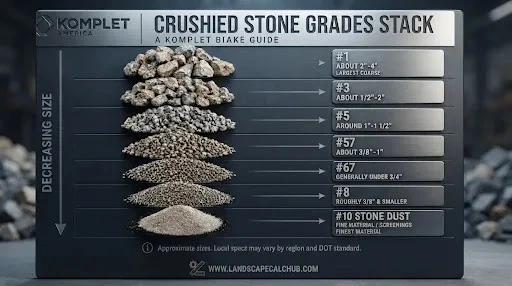
- Lower Numbers (#1, #2, #3): Represent larger, coarser stone. For example, #1 stone ranges from 2″ to 4″ in size and is used for heavy-duty logging roads or soft construction entrances.
- Mid-Range Numbers (#57, #67): Represent medium crushed stone. #57 stone passes through a 1-inch sieve screen down to a 1/2-inch screen, providing the ideal balance between drainage and stability.
- Higher Numbers (#8, #10): Represent fine material. #8 stone is tiny 3/8″ pea-sized chips, while #10 is pulverized stone dust used to bind gravel bases together.
Does Gravel Weigh More When Wet?
Yes, gravel weighs significantly more when wet. Because bulk aggregate is stored outdoors in open quarry stockpiles, rain and ground moisture fill the air gaps between rocks and soak into crushed fines.
- Moisture Weight Impact: Rain can increase total gravel weight by 5% to 15%, adding up to 200 to 300 lbs per cubic yard.
- Why Suppliers Quote Dry Density: Commercial quarries quote prices based on dry bulk density to ensure consistent pricing. However, when trucks drive onto the scale at the quarry gate, you pay for the actual scale weight. If you pick up stone immediately after heavy rain, you are paying for extra water weight trapped in the load.
What If My Gravel Type Isn’t Listed?
If you are using a unique regional stone—such as crushed basalt, lava rock, slate chips, or recycled crushed concrete—standard numbers won’t give you an exact match.
Most aggregate calculators allow a custom density entry (entered in pounds per cubic yard or tons per cubic yard). If your local supplier provides a specific weight spec, enter that number directly.
As a general rule for unlisted materials:
- Lightweight stone (Lava rock, expanded shale): Use 1,200 – 1,800 lbs/cu yd (0.60 – 0.90 tons/cu yd).
- Standard hard rock (Granite, limestone, quartz): Use 2,500 – 2,700 lbs/cu yd (1.25 – 1.35 tons/cu yd).
- Dense packed materials (Crusher run, DG, wet slag): Use 2,800 – 3,100 lbs/cu yd (1.40 – 1.55 tons/cu yd).
Gravel Calculator by Region and Unit
Measurement standards and delivery units for aggregate vary depending on where your project is located. While North American quarries primarily operate in imperial yards and short tons, UK and Canadian suppliers quote materials using metric standards.
Gravel Calculator UK (m² and tonnes)
In the UK, aggregate is specified and sold using square meters (m²), cubic meters (m³), and metric tonnes. Bulk bags (often called “dumpy bags”) typically contain around 800 kg to 850 kg of stone, while loose truck deliveries are quoted in metric tonnes (1 tonne = 1,000 kg).
UK Unit Formulas & Conversions
- Surface Area: Length (m) × Width (m) = Area in Square Meters (m²)
- Volume: Area (m²) × Depth (m) = Cubic Meters (m³)(Note: Convert depth from centimeters to meters first by dividing by 100. For example, 5 cm = 0.05 m.)
- Weight in Metric Tonnes: Volume (m³) × Bulk Density (tonnes/m³)
Standard UK Density Values: Standard 20mm gravel or 10mm pea shingle typically has a bulk density of 1.5 to 1.6 tonnes per cubic meter. Type 1 MOT sub-base (crushed granite or limestone with fines) averages 1.9 to 2.1 tonnes per cubic meter when compacted.
UK Worked Example:
For a gravel driveway measuring 10 meters long by 3 meters wide (30 m²) laid to a standard depth of 5 cm (0.05 m) using 20mm shingle (density of 1.5 tonnes/m³):
- Calculate Volume: 30 m² × 0.05 m = 1.5 m³
- Add Compaction / Waste (10%): 1.5 m³ × 1.10 = 1.65 m³
- Calculate Weight: 1.65 m³ × 1.5 tonnes/m³ = 2.48 metric tonnes
Gravel Calculator Canada / Metric (m³, metric tonnes)
Canadian suppliers work with a blend of metric volume and metric weight. While retail home centers sometimes display coverage in square feet, commercial aggregate yards and quarries quote bulk deliveries strictly in cubic meters (m³) or metric tonnes (1,000 kg ≈ 2,204.62 lbs).
Canadian Metric Conversions
- Cubic Meters to Metric Tonnes: Multiply total m³ by the specific material density in tonnes/m³.
- Converting Imperial to Canadian Metric:
- 1 Cubic Yard ≈ 0.7645 Cubic Meters
- 1 US Short Ton (2,000 lbs) ≈ 0.907 Metric Tonnes
Canadian Standard Density Reference Table
| Material Type | Density (tonnes/m³) | Typical Canadian Use Case |
|---|---|---|
| Clear Crushed Stone (19mm / 3/4″) | 1.50 – 1.60 tonnes/m³ | Driveway topcoats, drainage layers, concrete slab bases |
| Granular A / Crusher Run (with fines) | 2.10 – 2.20 tonnes/m³ | Compacted driveway base, patio base, roadway foundation |
| Pea Stone (10mm / 3/8″) | 1.55 – 1.65 tonnes/m³ | Dog runs, decorative walkways, playground ground cover |
| River Rock / Round Aggregate | 1.50 – 1.60 tonnes/m³ | Decorative garden borders, dry creek beds, erosion control |
Canadian Worked Example:
For a patio base in Ontario measuring 6 meters by 4 meters (24 m²) requiring a 10 cm (0.10 m) compacted base of Granular A (density of 2.1 tonnes/m³):
- Calculate Volume: 24 m² × 0.10 m = 2.4 m³
- Add Compaction Factor (15%): 2.4 m³ × 1.15 = 2.76 m³
- Calculate Weight: 2.76 m³ × 2.1 tonnes/m³ = 5.80 metric tonnes
Types of Gravel and Which One to Choose
Selecting the right aggregate depends on whether your priority is structural load support, efficient drainage, or a comfortable walking surface. The table below breaks down the four most common stone types used in residential landscaping and driveway projects.
Gravel Material Characteristics & Cost Comparison
| Material | Size Range | Drainage | Compaction | Best Use | Approx. Cost/Ton |
|---|---|---|---|---|---|
| Pea Gravel | 1/4″ – 3/8″ | Excellent | Low | Patios, walkways, dog runs, flower beds | $35 – $65 |
| Crushed Stone (#57 / 3/4″) | 1/2″ – 1″ | Excellent | Moderate | Driveway surface caps, French drains, concrete mix | $25 – $50 |
| River Rock | 1″ – 3″+ | Excellent | Very Low | Decorative garden borders, dry creek beds, erosion control | $50 – $100 |
| Decomposed Granite (DG) | Fines to 1/4″ | Fair | Very High | Rustic pathways, high-traffic footpaths, patio bases | $40 – $75 |
Pea Gravel
Pea gravel consists of naturally rounded, smooth stones harvested from riverbeds or gravel pits. Because the individual rocks lack sharp, angular edges, they roll underfoot rather than locking together, making pea gravel ideal for comfortable barefoot walking paths and patios but poor for sloped driveways.
Crushed Stone (#57 / 3/4″)
Machine-crushed angular rock—typically limestone, granite, or trap rock—provides sharp edges that interlock tightly when driven on or rolled. Size #57 clean stone stays in place on driveways while allowing water to pass directly through the gaps, preventing puddles and erosion.
River Rock
River rock features large, smooth, rounded stones prized primarily for their decorative appeal and natural color variations. Because of its large size and poor interlocking ability, it is rarely used for driveways or main walking paths, functioning best as a low-maintenance mulch alternative or drainage channel lining.
Decomposed Granite (DG)
Decomposed granite is a mix of tiny granite chips and ultra-fine silt that packs down into a firm, solid surface reminiscent of a hard-packed dirt road. When mixed with a stabilizing binder, DG creates a smooth, semi-rigid path that resists erosion while offering a natural, earthy finish.
Gravel vs. Crushed Stone vs. Aggregate — What’s the Difference?
While these terms are often used interchangeably on job sites, they refer to specific categories in civil construction.
- Aggregate is the broad umbrella term for any raw geological material used in construction, including sand, gravel, crushed rock, and slag.
- Gravel specifically refers to naturally weathered, water-worn, or rounded stones gathered from natural deposits.
- Crushed Stone is a man-made aggregate produced by mechanically blasting and crushing large quarry rock into sharp, angular sizes.
Gravel Calculator for Specific Projects
Different landscape and construction jobs demand specific gravel grades, depths, and compaction considerations. Using the wrong depth or stone type can cause driveways to rut, walkways to shift underfoot, or drainage trenches to clog over time.
Gravel Depth & Construction Role Guide
| Project Type | Recommended Depth | Best Gravel Type | Primary Construction Role |
|---|---|---|---|
| Driveways | 4″ – 6″ (Base) + 2″ – 3″ (Top) | Crusher Run (Base), #57 Crushed Stone (Top) | Structural support, tire traction, wheel rut prevention |
| Walkways & Paths | 2″ – 3″ | Pea Gravel, Decomposed Granite (DG) | Foot comfort, smooth walking surface, decorative edging |
| Drainage & French Drains | 8″ – 12″ | #57 Clean Crushed Stone (1/2″ – 1″) | Water filtration, pipe protection, preventing soil silt buildup |
| Decorative & Landscaping | 2″ – 3″ | River Rock, Polished Pea Gravel | Weed suppression, soil moisture retention, visual edging |
Driveway Gravel Calculator
Driveways require a multi-layer strategy rather than a single layer of stone dumped on open soil. For a long-lasting gravel driveway, install a 4 to 6-inch base layer of sub-base material (like Crusher Run or #3 stone) compacted directly onto geotextile fabric, followed by a 2 to 3-inch top coat of clean aggregate.
Driveways need significantly more volume than flat garden beds because car and truck tires exert hundreds of pounds of point pressure, driving stone down into soft soil if the foundation is too shallow. The best gravel type for a driveway top layer is #57 crushed angular limestone or granite—the sharp, fractured edges interlock to form a rigid driving surface that stays in place under heavy tire traffic.
Walkway & Path Gravel Calculator
Footpaths require a lighter depth of 2 to 3 inches. Avoid applying stone deeper than 3 inches on walkways, as deep loose gravel creates a “marshmallow effect” that causes shoes, heels, and wheelbarrows to sink.
Smaller, rounder aggregates—such as 3/8-inch pea gravel or decomposed granite—are ideal for paths. Pea gravel provides a comfortable surface for foot traffic, while decomposed granite packs down to create a smooth, accessible surface for strollers and garden carts.
French Drain Gravel Calculator
Calculating stone for a French drain involves determining the total trench volume minus the displacement volume of the perforated drain pipe. Most residential drainage trenches are 12 inches wide and 18 to 24 inches deep, requiring an 8 to 12-inch envelope of gravel surrounding a 4-inch pipe.
Always use #57 washed clean crushed stone (1/2″ to 1″) for drainage trenches. Clean stone lacks fine dust or sand particles, leaving open void spaces between rocks that allow water to flow freely into the pipe without clogging the trench.
Gravel Base Calculator
Patios, garden sheds, hot tub pads, and paver installations require a firm, level sub-grade known as a gravel base. A gravel base (or “base rock”) refers to a dense-grade aggregate mixture containing both crushed stone chips and fine stone dust that packs down tight under a plate compactor.
Because base materials pack down significantly when rolled or tamped, always add a 15% to 20% compaction allowance to your raw volume calculations to ensure your finished slab or paver surface hits the targeted finished height.
General Fill Gravel Calculator
General fill gravel is used for grading low spots in a yard, backfilling around foundation footings, or raising ground levels prior to topsoil placement.
Unlike a engineered gravel base—which sits directly under a structure being built to support heavy weight—general fill uses broader, lower-cost aggregates (such as unscreened bank run or bank-run gravel) where structural interlock and exact sizing are secondary to bulk volume.
How Much Does Gravel Cost?
On average, bulk gravel costs $25 to $60 per ton (or $40 to $75 per cubic yard) for standard materials like crushed limestone, #57 stone, and pea gravel. Premium decorative options—such as white marble chips, river rock, or polished pebbles—run between $60 and $100+ per ton.
- Material Price Ranges: Standard base materials and crushed gravel sit at the lower end ($25–$45/ton), while smooth, sorted decorative stones sit at the higher end ($50–$100+/ton).
- Delivery vs. Pickup Costs: Hauling stone yourself in a pickup truck avoids freight fees, but standard trucks can usually only carry 1 to 1.5 tons per trip without overloading the suspension. Commercial quarry deliveries usually charge a flat gate/delivery fee of $50 to $150 per trip regardless of whether you order 3 tons or a full 15-ton dump truck load.
- Calculating Project Cost: Entering your local supplier’s price per ton or per cubic yard directly into the calculator’s optional cost field instantly multiplies your total calculated volume (including compaction allowance) by the unit rate to give you an accurate baseline material estimate.
Buying Gravel by the Bag vs. by the Yard/Ton
For small touch-ups, single flower beds, or repair jobs under 10 cubic feet, buying bagged gravel from home improvement centers (like Home Depot, Lowe’s, B&Q, or Wickes) is usually the most convenient option. However, for any full driveway or large patio base, bulk delivery is drastically cheaper.
- Bag Coverage & Pricing: A standard retail bag of gravel typically holds 0.5 cubic feet (approx. 0.018 cubic yards or 20 kg) and costs $4 to $6 per bag (or £5 to £8 in the UK). To get 1 full cubic yard of stone, you would need 54 individual bags, totaling roughly $216 to $324.
- Bulk Yard/Ton Pricing: A bulk cubic yard of the same material delivered by a local aggregate yard typically costs $40 to $75 total.
- When Bagged Makes Sense: Bagged stone makes sense when your project requires less than 15 to 20 cubic feet, when you lack space for a loose dirt/stone pile on your driveway, or when you need to carry stone through a narrow gate in small batches.
- When Bulk Delivery Makes Sense: Bulk delivery is essential for any project requiring more than half a cubic yard (~14 cubic feet). Buying bulk saves you up to 75% on material costs and saves hours of tearing open individual plastic bags.
Accounting for Overage and Compaction
Ordering the exact theoretical volume of gravel calculated from your surface measurements almost guarantees you will run short before the job is finished. Ground conditions in the real world never match perfect mathematical models, so factoring in material loss and compaction is essential to getting a full, long-lasting installation.
- Why Order 10% Extra for Overage: Every aggregate project experiences material loss during handling and installation. Loose stone sinks into uneven sub-grade dirt, gets spilled along the borders during shovel work, or gets mixed into the topsoil when spread. Ordering a 10% waste buffer accounts for minor measurement errors, irregular soil beds, and natural spillage.
- Compaction Loss for Base Layers: When loose aggregate—especially dense base materials containing fine dust (like Crusher Run or Granular A)—is rolled or tamped with a plate compactor, air voids collapse and stone particles interlock tightly. This process reduces the overall thickness by 20% to 30%. If you need a 4-inch compacted sub-base for a driveway, placing 4 inches of loose stone will leave you with less than 3 inches of compacted depth after rolling. Driveway and road-base installations must order significantly more than the raw void volume to reach their target structural depth.
- Official Transportation Standard: According to the Federal Highway Administration (FHWA) Gravel Roads Maintenance and Design Manual, uncompacted aggregate base and surface gravel experience significant bulk volume reduction during mechanical compaction, requiring an additional volume allowance of up to 20% to 30% during application to achieve the necessary density and structural load capacity.
Common Mistakes That Leave You Short on Gravel
Underestimating aggregate requirements is one of the most frustrating errors in landscape and hardscape construction. Running out of stone mid-project stalls work, wastes time, and incurs extra delivery charges. Avoid these four common pitfalls when calculating your order.
- Measuring Only One Layer on a Driveway: A lasting gravel driveway requires both a sturdy foundation and a stable surface cap. Measuring only for the top layer of decorative aggregate while ignoring the 4 to 6-inch base layer of dense aggregate (like Crusher Run) means ordering only a fraction of the total rock required to build a lasting driveway.
- Ignoring Compaction on Fill and Base Jobs: Calculating simple volume (length × width × depth) gives you the uncompacted, loose volume of stone. Once rolled or tamped with a plate compactor, loose base gravel loses 20% to 30% of its depth as air gaps collapse. Failing to add a compaction factor guarantees your finished base will fall below your planned elevation.
- Using a Generic “Gravel” Density Value: Assuming all gravel weighs the same leads to major tonnage errors. Lightweight, uniform materials like pea gravel weigh around 2,600 lbs per cubic yard, while dense stone mixes with fine dust weigh upwards of 2,900 to 3,000 lbs per cubic yard. Using a generic average for a heavy aggregate results in ordering too few tons at the scale.
- Not Rounding Up to Commercial Delivery Increments: Quarries and aggregate yards do not deliver fractional loads down to the exact pound. Commercial dump trucks usually sell by full or half-ton increments, and bulk bags come in fixed weights. If your project math calls for 6.2 tons, rounding down to 6 tons leaves you short, whereas rounding up to 7 tons ensures complete coverage.
Frequently Asked Questions
For a standard single-car driveway (10 ft wide × 20 ft long) with a standard depth of 4 inches, you will need approximately 4 to 4.5 tons of gravel. For a standard two-car driveway (20 ft wide × 20 ft long), you will need roughly 8 to 9 tons.
One ton of standard gravel covers approximately 80 to 100 square feet when laid at a standard depth of 2 inches. If laid at a 4-inch depth (common for base layers), one ton covers roughly 40 to 50 square feet.
Quarries and large aggregate yards typically sell gravel by the ton (measured using weight scales), while landscape supply centers often sell by the cubic yard (measured using tractor loader buckets). As a rule of thumb, 1 cubic yard of gravel weighs about 1.35 to 1.5 tons.
A standard single-axle dump truck carries around 5 to 7 cubic yards (approx. 7 to 10 tons), costing between $300 and $600 including delivery. A large commercial tri-axle dump truck holds 12 to 14 cubic yards (approx. 16 to 20 tons) and costs roughly $600 to $1,200 depending on stone type and local hauling distance.
A durable gravel driveway should have a total depth of 4 to 6 inches laid in compacted layers over subgrade soil. For new construction, contractors recommend a 4-inch base layer of coarse stone (like Crusher Run) topped with a 2-inch surface cap of sharp decorative stone.
Gravel is naturally formed by erosion and features smooth, rounded edges (e.g., river rock or pea gravel). Crushed stone is mechanically pulverized rock (such as limestone or granite) with sharp, angular edges. Crushed stone locks together when driven over, making it far superior for structural driveways.
The best material for a driveway surface is Crusher Run (also called Dense Grade or Quarry Process) or #411 Crushed Stone. These feature angular gravel mixed with stone dust, creating a tightly packed, firm surface that resists shifting and rutting.
One cubic yard of dry, loose gravel weighs approximately 2,700 to 3,000 pounds (1.35 to 1.5 US tons). Wet or tightly compacted aggregate can weigh up to 3,200 pounds (1.6 tons) per cubic yard.
For a 10×10 ft area (100 sq ft) at a 3-inch depth, you will need 0.93 cubic yards, which equals approximately 1.3 tons of gravel (or roughly 50 bag units of 0.5 cu ft gravel bags).
Yes! This tool calculates material quantities for driveways, footpaths, patio bases, French drains, and garden beds. You can enter your local price per ton or cubic yard to instantly estimate your total project delivery cost.
Related Calculators — And Which One You Actually Need
If your project involves materials other than loose rock and crushed aggregate, use one of our specialized calculation tools to ensure precise ordering specs:
- Concrete Calculator: Use this tool when pouring solid slabs, footings, post holes, or structural foundations requiring mixed concrete rather than loose rock.
- Mulch Calculator: Calculate organic ground cover volume (such as wood chips, bark, or shredded mulch) to regulate soil temperature and retain garden bed moisture.
- Sand Calculator: Determine exact tonnage and cubic yards for concrete sand, masonry sand, or leveling beds used beneath paver patios and above soil.
- Paver Calculator: Estimate the exact quantity of concrete, clay, or natural stone paver units needed to tile a patio, walkway, or driveway surface.
- Square Footage Calculator: Quickly determine the total base surface area (in square feet or square meters) for complex, multi-shape landscape footprints before applying depth formulas.
Which Tool Do You Need?
To keep your calculations accurate, choose the tool built specifically for your surface material. If you are building a solid, poured driveway or foundation, use the Concrete Calculator. If you are covering planting beds with organic bark or soil amendments, switch to the Mulch Calculator or Topsoil Calculator. This page is calibrated specifically for loose stone, bulk aggregate, and crushed rock densities.